Philadelphia’s Main Line suburbs recorded their strongest year of home price growth in over a decade, with the median sale price rising 11.4% year-over-year to $620,000 as buyers pushed westward from the city in search of space, top-rated schools, and commuter rail access.
The Main Line Market at a Glance
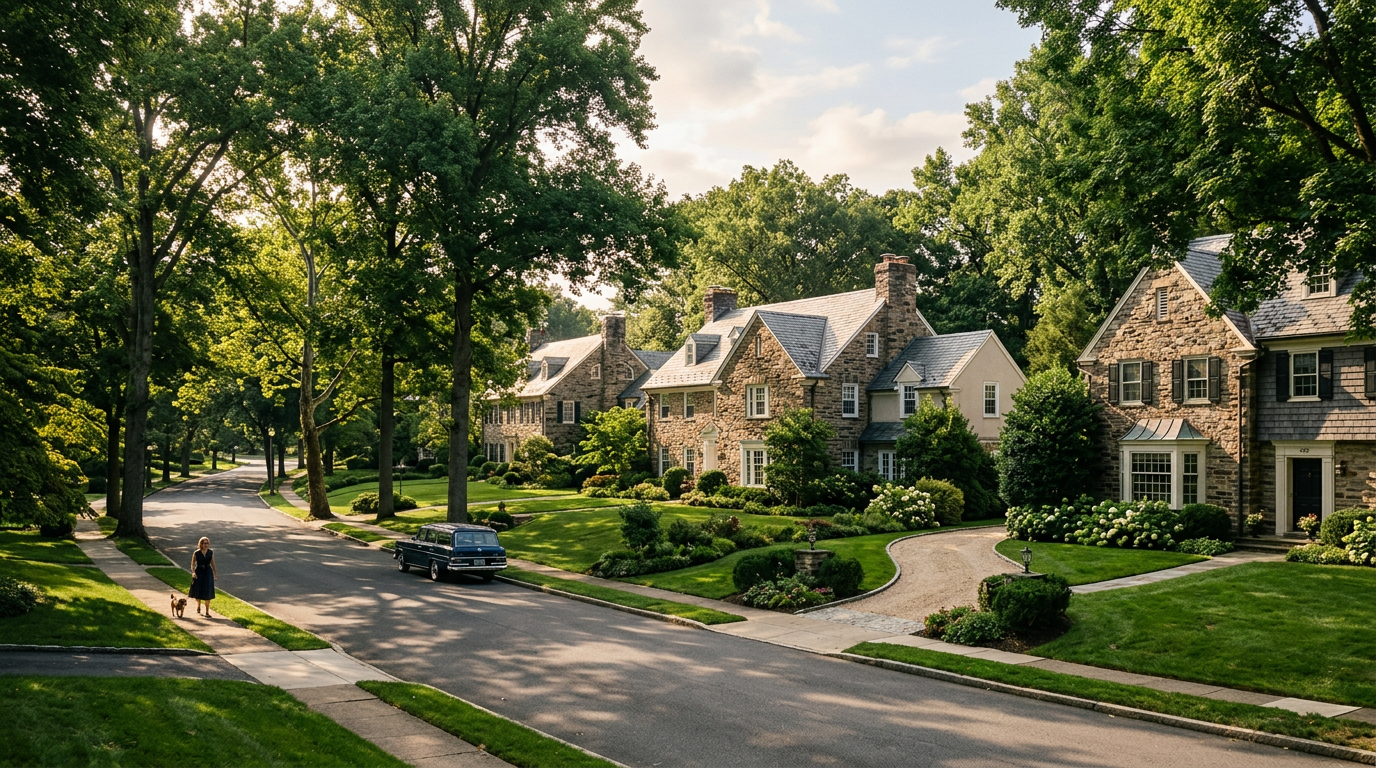
The Main Line — the string of affluent suburbs along the historic Pennsylvania Railroad corridor west of Philadelphia — has long been one of the region’s most desirable residential markets. But 2026 has brought a level of price acceleration not seen since the post-pandemic surge of 2021.
Key market statistics for the twelve months ending August 2026:
- Median sale price: $620,000 (up 11.4% year-over-year)
- Closed sales: 3,840 (up 6.2% year-over-year)
- Median days on market: 14 (down from 22 a year ago)
- Sale-to-list price ratio: 99.1% (up from 97.4%)
- Active listings: 520 (down 18% year-over-year)
- Months of supply: 1.6 (the lowest on record)
The supply shortage is the defining feature of the current market. With just 1.6 months of inventory on hand, the Main Line is one of the tightest markets in the entire Philadelphia metropolitan area.
What’s Driving the Surge
1. City-to-suburb migration. After several years of elevated mortgage rates keeping city buyers in place, a growing cohort of Philadelphia homeowners is selling and moving west. Remote and hybrid work arrangements have made the trade-off of a longer commute acceptable in exchange for larger lots and better school districts.
2. School district demand. The Main Line’s public school districts — Lower Merion, Radnor, Tredyffrin-Easttown, and Great Valley — consistently rank among the best in Pennsylvania. For families with children approaching school age, this is the single most cited reason for making the move.
3. Inventory scarcity. The Main Line’s built environment is largely mature, with limited land for new construction. Zoning restrictions in communities like Lower Merion and Radnor further constrain new supply, so demand is chasing a nearly fixed stock of homes.
4. Premium for space. The post-pandemic preference for larger homes and yards remains intact. Main Line properties average 3,200 square feet on lots averaging 0.4 acres, compared to Philadelphia’s city average of 1,400 square feet on much smaller lots.
Submarket Breakdown
The Main Line is not monolithic. Price points and dynamics vary significantly by community:
- Lower Merion: Median $780,000, up 9.8%. The most expensive Main Line community, anchored by Villanova and Ardmore. Inventory is extremely tight at 1.2 months.
- Radnor: Median $720,000, up 12.1%. Radnor’s top-ranked schools and proximity to the city make it the most competitive submarket, with homes regularly receiving multiple offers within days of listing.
- Tredyffrin-Easttown: Median $590,000, up 13.4%. The strongest price growth on the Main Line, driven by relative affordability compared to Lower Merion and Radnor, plus excellent schools.
- Great Valley: Median $540,000, up 10.2%. The most affordable Main Line community, attracting buyers priced out of the eastern submarkets.
- Malvern/Frazer: Median $510,000, up 14.1%. The western edge of the Main Line is seeing the fastest appreciation as buyers push further out for value.
Impact on the Rental Market
The Main Line’s sales market tightness is spilling into rentals. With homeownership increasingly out of reach for many households — a 20% down payment on the median $620,000 home requires $124,000 in cash, plus closing costs — demand for rental units is rising.
- Average asking rent: $2,650/month (up 5.8% year-over-year)
- Vacancy rate: 3.4% (down from 4.1% a year ago)
- New apartment deliveries: 280 units in 2026, the lowest in three years
Single-family rentals are particularly scarce. Investors who acquired Main Line rental properties in recent years are seeing strong rent growth and low turnover, as tenants who cannot afford to buy are staying in rentals longer.
What This Means for SFR Operators
For single-family rental investors and property managers, the Main Line presents a distinct set of opportunities and challenges:
- High barriers to entry. Acquisition prices are steep, and cap rates are low (3.5-4.5%). Cash-flow investors will find better numbers in Philadelphia proper or in emerging suburban markets like Norristown or Coatesville.
- Strong appreciation potential. For investors with a longer horizon, the Main Line’s supply-constrained market and enduring school-district demand support continued price appreciation.
- Tenant quality and retention. Main Line renters tend to be stable, high-income households. Turnover is low, and tenants treat properties well.
- Rent growth support. With homeownership costs rising faster than rents, the rental pool is growing, supporting continued rent increases of 4-6% annually.
Outlook
The Main Line market shows no signs of cooling in the near term. With inventory at record lows, school demand unwavering, and city-to-suburb migration continuing, prices are likely to keep rising at a 7-10% annual pace through 2027. The main risk factor is mortgage rates — a meaningful decline could unlock a wave of additional buyers and push prices even higher, while a further increase could cool demand at the margins.
For now, the Main Line remains one of the strongest residential markets in the Philadelphia region, and one of the most difficult for buyers and renters alike.